rev. 11/17/25
Note: The format for Exam #3 will be slightly different from the previous exams. It will be 30 minute exam as before, but will consist of three sections. A very short answer section (5 mins., with choices, 20%) and two short essays (10-15 mins. each, 40% each), one on Jay Winter and one on George Orwell.
Big Questions for the Mini-Essay. I will ask you about
- Jay Winter’s Sites of Memory, Sites of Mourning…
- George Orwell’s Homage to Catalonia…
Concepts of Historical Analysis
What are the central concepts of historical analysis?
– The Five C’s of Historical Analysis
– Change and continuity. What changes? What stays the same?
– Context. What was the historical context of the time?
– Causality. What are the forces of change?
– Contingency. How might events have turned out differently?
– Complexity. Events are often shaped by multiple events. Experiences vary dramatically by time and place. The same event may be experienced very differently by individuals from different positions.
Historical Research
What are the steps of historical research? Identify a topic, develop an interesting historical question or research question, understand the historiography on the topic, analyze primary sources, present an argument, examine evidence to support the argument, explain the significance of your work.
Working with Primary Sources
What is a primary source? Documents that provide first-hand evidence of the topic at hand. These primary sources include documents that are contemporary with the events under study, such as newspaper articles, trial transcripts, diaries, letters, reports, legislative documents, etc. They also include first-hand accounts at a distance to the past, such as memoirs and oral history interview transcripts. They include imaginative works, such as novels and poems, visual works, such as photographs and paintings, complex creative works, such as films and music, material culture, such as jewelry and pottery, and more.
How should you analyze a primary source?
- First answer some basic questions: Who is the author? When and where was it produced? Who was it produced for? What does it purport to be? What story does it tell?
- And then develop your own perspective. Some questions that might follow: How does the source work? How is it constructed? What is its internal logic? What views or assumptions are revealed here? What is missing here? Are there important silences? Or obfuscations? What does the source reveal about its author? What does the source reveal about the context in which it was written? What do historians say about the source? Do you see something different in it? What?
Working with Secondary Sources
- What is a secondary source? The term is used differently by different people. For our purposes, it is a scholarly book or article.
- Historiography refers to the body of secondary sources by historians on a topic – or, more generally, to the ways in which historians have approached a particular topic.
- What is a historical monograph? A book by a historian devoted to a particular topic, presenting an argument. We can distinguish it from articles, textbooks and surveys (which are secondary sources but not monographs).
- How should a historian read a historical monograph to understand the argument? Read the introduction very carefully. Here is where the author will lay out the topic and the argument. Read book reviews from historical journals (this is not cheating).
- How do historians create new histories? They ask research questions. They look to overlooked sources or events. They look at these sources or events in new ways. They respond to previous arguments and develop new arguments.
Jay Winter and the Memory of the First World War
Jay Winter, Sites of Memory, Sites of Mourning: The Great War in European Cultural History (Cambridge University Press, 1998)
American historian, retired now from Yale. Expert on the WW1 and the study of memory. Also involved in public history, having co-produced an important documentary on WW1 and participating in the design and establishment of a historical museum and memorial at the Historial de la Grande Guerre at the site of the Somme.
In Sites of Memory, he investigates the ways in which European societies in Britain, France, and Germany, processed the grief of the war and its devastation. He asks, most simply, how was the war remembered.
His argument is an argument for continuity. In contrast to those who have argued that the Great War marks a decisive break in European culture and the birth of modernism, Winter shows the ways in which traditional modes of aesthetic expression were used to make sense of the war and its grief. His book is a cultural history and a comparative history that looks beyond borders to understand European responses to the war. Emphasizing the “universality of grief and morning,” he draws examples from low culture and high culture; indeed, arguing that the war collapsed distinctions between the two. In the conclusion, Winter suggests that the real break in the memory of war came in the aftermath of 1945, a war that could not be processed through traditional modes.
Some relevant examples:
– Paul Fussell, The Great War and Modern Memory, for the argument of change
– Abel Gance, J’Accuse and the return of the dead
– Tomb(s) of the Unknown Soldier
– The Cenotaph of London
– Monuments to the dead
– Ossuary at Douaumont
– The “Trench of the Bayonets”
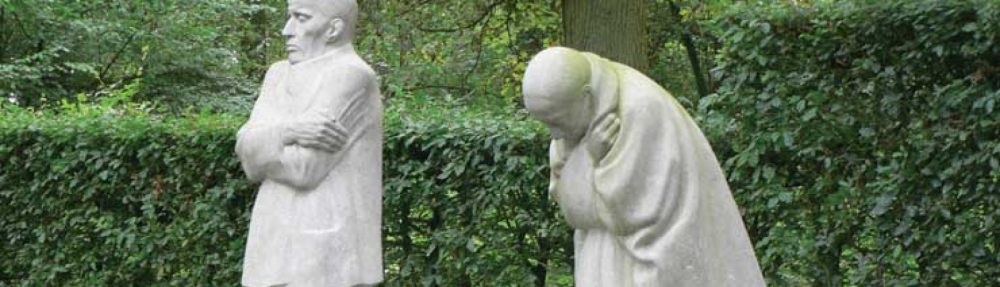
– Kathe Köllwitz, Grieving Parents
– Images d’Épinal
– Otto Dix, The War, and the apocalyptic imagination
– Henri Barbusse, Under Fire, and the apocalyptic imagination
– The poetry of Apollinaire, recasting tradition
– Paul Klee, “Angelus novus” (1920) – Walter Benjamin views it as the angel of history, looking backwards on disaster
We considered some critiques:
– Against idea of “universality” of experience and “timelessness” of artistic responses
– Pointing out limits to this as a European study. Emphasis is on Britain and France
– A caricature view of tradition and modernity
George Orwell, Homage to Catalonia (orig. 1938). Names and Details
Orwell’s background: lower middle class, scholarship student, policeman in Burma, anti-totalitarian writer. Famous for Animal Farm (1944), 1984 (1949), and for his “Rules for Writers”
Goes to Spain to write about it but joins in the fight because “it seemed the only conceivable thing to do.” Joins the POUM militia, fights on the Aragon front, participates in the May Events in Barcelona in 1937, back at the front he is wounded, returns to Barcelona, under threat of arrest, returns to England
A short stay in Spain, 6 or 7 months – (December 1936 to June 1937)
Wider context of the 1930s – democracy under siege, international powers respond very differently to events in Spain
Backdrop: The Spanish Second Republic, 1931-1936 (instability, the “black years” of 33-34, CEDA)
– The Popular Front Government, an alliance of anarchists, socialists, communists, and liberals
– Nationalists, a loose association of monarchists, army officers, fascists, and conservatives
– General Mola and General Francisco Franco
– Catalonia
– Barcelona in December 1936 (what does it look like? Socialism in practice…)
– What is socialism, according to Orwell? Not state ownership of means of production, but equality, an end to class society…
– P.O.U.M. militia. Anti-Stalinist Communist militia. Motto: war and revolution are intertwined
– Orwell brings English perspectives (on time, military training, railway schedules, money, and more…)
– C.N.T./F.A.I. (Anarchist trade unions)
– P.S.U.C. (the Communists of Catalonia). Supported by Stalin. Motto: win the war first; revolution can come later
– The Generalitat – the Catalan government, increasingly controlled by the PSUC
– The international context: the arms embargo of Britain and France, the role of Germany and Italy the Soviet Union and the Comintern
– The Popular Army, organized on traditional military lines, destined to incorporate all of the militias
– What does Orwell’s experience of war look like?
– How was Orwell’s unit’s first casualty taken?
– What does Orwell want to do?
– How well can Orwell speak Spanish? Catalan?
– Propaganda in wartime… Includes propaganda by megaphone at the front (the “real weapon of war” on the Aragon front)
– The May Events of Barcelona in 1937. 400 d. in fighting between the government and the militias. What are these events about? The Communist party and the government of Catalonia wanted to take control of the city and limit the role of the POUM
– Distortions of the international press. For the London press – the London Times, the Daily Worker – the POUM was a front for the fascists
– What is on the inside of a goatskin wine bottle?
– What are Orwell’s last days in Barcelona like? He’s on the run, subject to arrest as a member of the POUM, sleeping outside at night, trying to help friends (such as Georges Kopp) and preparing to leave.
– When (acc. to Orwell in 1937) will the English awake from “the deep, deep sleep of England”?
How might we interpret Orwell’s memoir? I suggested three approaches:
– Portrait of an international crisis of the left
– A political coming of age story
– An innocent abroad
Liberty for Us (released 1931)
A film by René Clair, a popular filmmaker who made film from the era of silent films in the 1920s until the 1960s. His films are noted for their comedy and with and embrace of the common people.
Liberty was made in 1931, before the effects of the depression hit hard in France. It is a film that celebrates friendship and leisure. Work is a Taylorized nightmare, akin to prison.
The central characters:
– Emile, who helps his friend escape from prison – can’t fit into the world of work
– Louis, who becomes rich selling phonographs
– Jeanne, who wants to escape the strictures of her protective uncle
– Others: other workers, Paul, Louis’ wife, the criminal band, the police, the government speaker at the opening of the factory, etc.
Some questions to think about:
– What does work look like in the film?
– How does any of this resonate with the history of the interwar period and the coming of the Depression?
– What can this particular film, the product of one filmmaker, tell us about the values of France in 1931?